
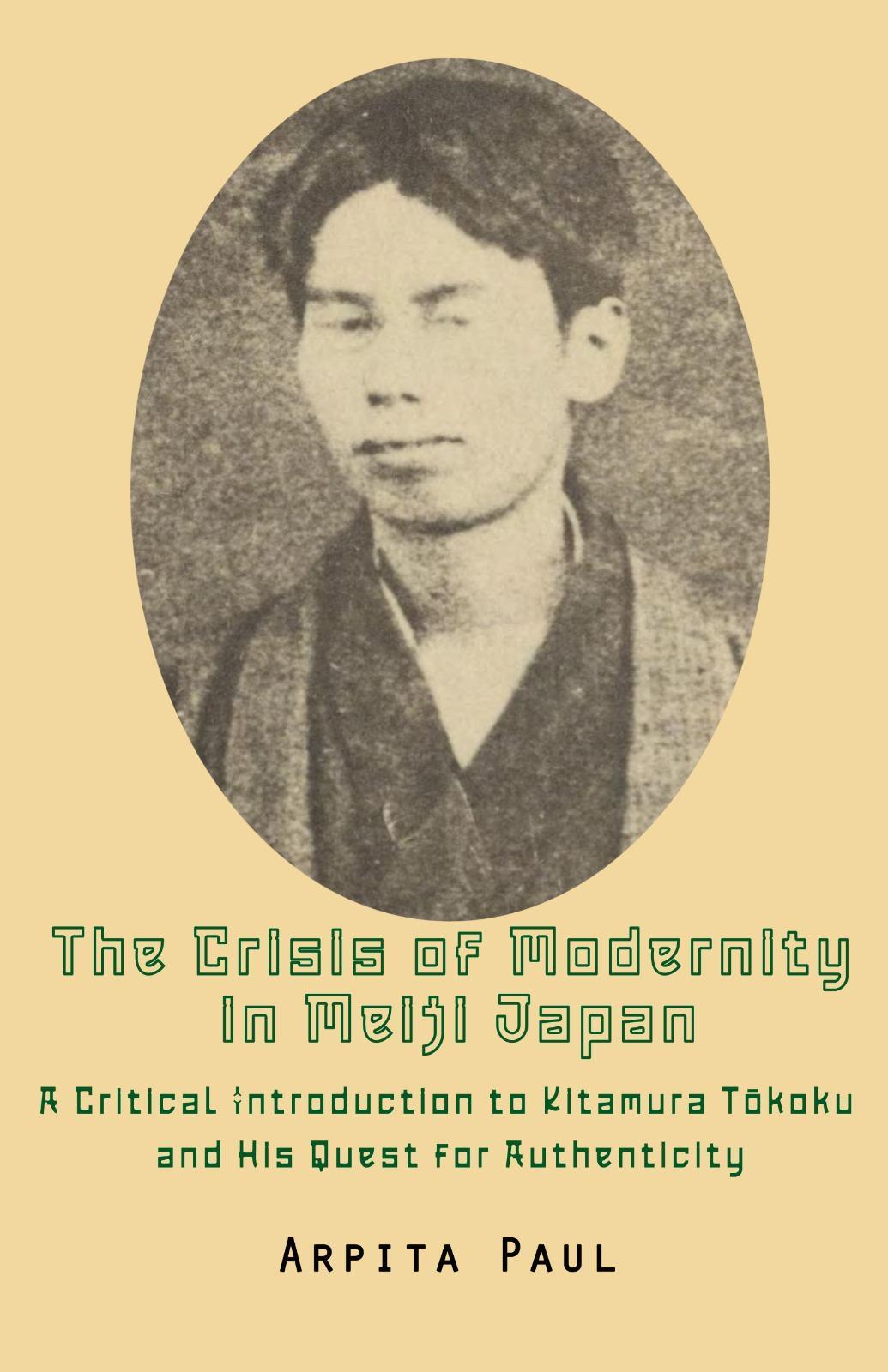
The Crisis of Modernity in Meiji Japan: A Critical Introduction to Kitamura Tōkoku and His Quest for Authenticity
Save ₹100.00 on this edition
The Meiji era (1868–1912) was a turning point in Japanese history—an age of dramatic change, bold experimentation, and deep spiritual questioning. The Crisis of Modernity in Meiji Japan: A Critical Introduction to Kitamura Tōkoku and His Quest for Authenticity invites readers into this turbulent world through the life and thought of one of its most captivating minds.
For Meiji enthusiasts and Tōkoku admirers alike, this book offers a penetrating and accessible study of a thinker who helped shape Japan’s modern consciousness. Through years of research and translations, the author brings together Tōkoku’s metaphysical essays, letters, and critical writings to reveal a restless spirit seeking truth amid a rapidly changing society.
The book illuminates how Tōkoku blended Western transcendentalism—especially Emerson’s call for ‘self-reliance’—with Asian philosophical traditions such as Yangmingism. This unique fusion became his compass in resisting the growing materialism of the age and in articulating a deeper vision of authenticity.
Engaging, insightful, and richly contextualized, this study repositions Tōkoku as a vital bridge between Romanticism and modern Japanese thought. It is both a rediscovery of a profound literary mind and an invitation to reflect on the timeless struggle between spiritual depth and the pressures of modernity.

Arpita Paul
AuthorDr. Arpita Paul is an Assistant Professor in the Department of Japanese Studies at Visva-Bharati University, Santiniketan (India). She has been awarded the Japan Foundation Japanese Studies Fellowship(2025-26) under Ministry of Foreign Affairs, Japan, for her postdoctoral researchin Japan at Daito Bunka University.
Dr. Paul has previously been a Visiting Fellow at the Kansai International Exchange Center in Osaka (2010) and as a Senior Research Fellow at Tokyo Gakugei University (2017).She earned her Ph.D. in Japanese Literature from the Centre for Japanese Studies, Jawaharlal Nehru University (JNU).Her major academic coordination of the MHRD e-PG Pathshala Project (2017–2019) as a content writer for Japanese culture modules stands as a testament to her commitment to accessible, high-quality scholarship, enriching Japanese Studies education across India.
Her research explores intellectual trends in the Meiji period, focusing on the dialogue between Western transcendentalism—particularly Emerson’s thought—and modern Japanese spiritual philosophy, alongside the influence of Wang Yangming studies on Meiji intellectuals. Her study on social dynamics and syncretic shifts, examining the reception of Emersonian philosophy in late 19th-century Japan, has been widely published in Indian and Japanese academic circles, reflecting her deep interest in cross-cultural philosophical exchange.
Highlights
More like this
Sri Aurobindo, Global Tradition and Beyond
Sarani Ghosal Mondal, Goutam Ghosal
₹499.00
₹599.00
Revisiting Ancient Aesthetics: Poetry of Walt Whitman and Sri Aurobindo
Sarani Ghosal Mondal
₹499.00
₹599.00
Revolt of the Educated
Wolfgang Kraushaar
₹599.00

France the Great Upheaval
Daniel Boeri
₹549.00

Amal: The Reception of Rabindranath Tagore's Play in France
Fabien Chartier
₹799.00
Follow us