
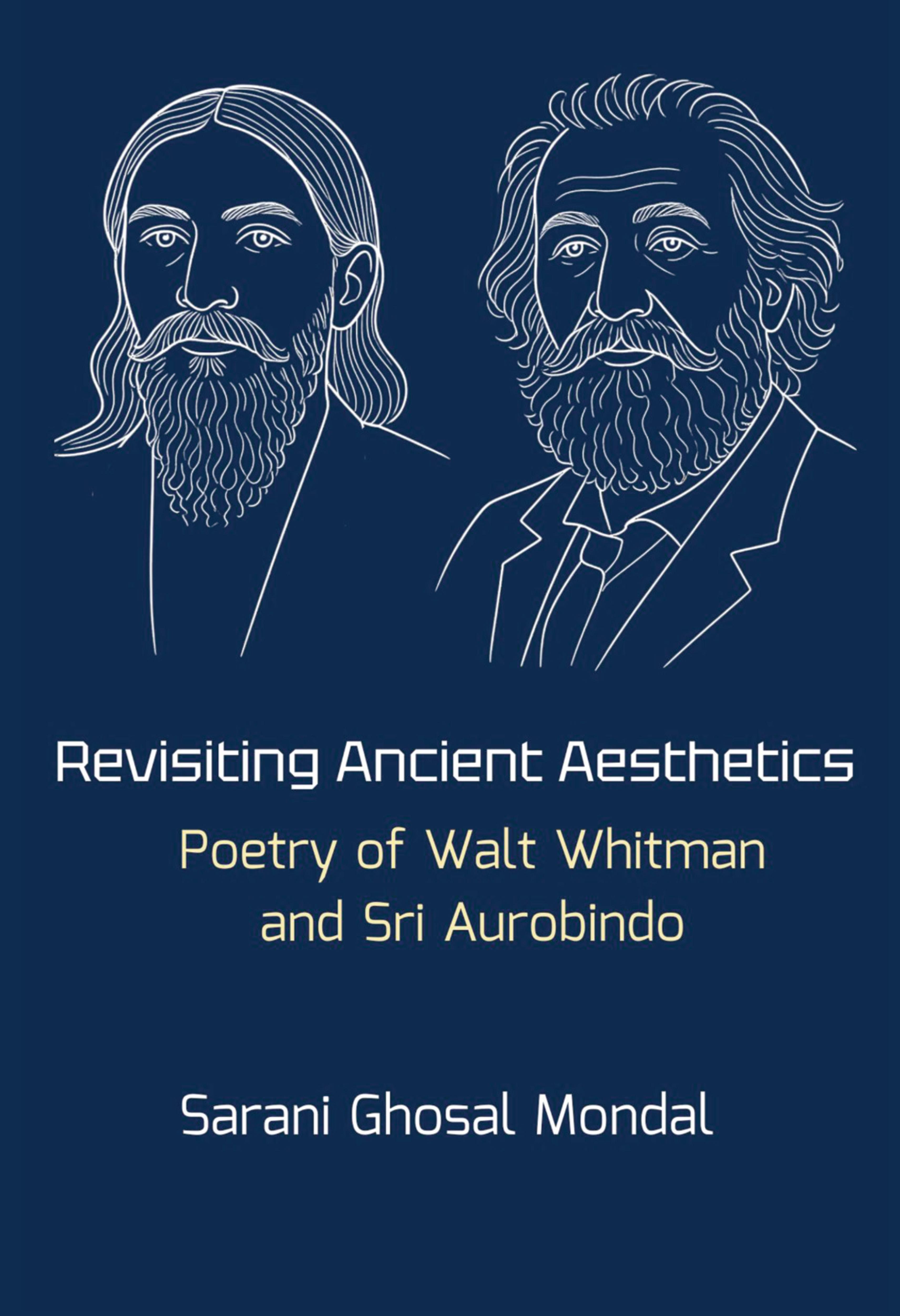
Revisiting Ancient Aesthetics: Poetry of Walt Whitman and Sri Aurobindo
Save ₹100.00 on this edition
Sri Aurobindo found his own integral worldview with Vedic-Upanishadic thought universe as its centre, in Walt Whitman; the vision of the Great Spirit rooted everywhere in the earth, the individual’s capacity to be in contact with that, and the Spirit itself yearning to light up material life. Whitman was the first to realise cosmic consciousness in poetry in lines of miraculous abundance. Sri Aurobindo found in Leaves of Grass “a great revolution in the whole method of poetry”, meaning both the rolling cadence and the stamp of divinity in its large universal substance. He takes a cue from Whitman’s poetry, as also from his theory of poetry, and begins a new era of poetry in the twentieth century, especially between 1930 and 1950. Sarani Ghosal Mondal argues that in this earth affected by war and human disharmonies, the poetry of Walt Whitman and Sri Aurobindo might work as a transfiguring force, initiating an expansion in human consciousness, a growth of love and kindness, paving the way to human unity.

Sarani Ghosal Mondal
AuthorSarani Ghosal Mondal is an Associate Professor of English in the department of Humanities and Social Sciences at NIT Goa. She has been engaged in Sri Aurobindo research for over two decades and has written and lectured extensively on Sri Aurobindo’s poetry, plays and prose. Her other areas of interest include Applied Linguistics, Culture Studies and Comparative Mysticism. She is the recipient of NoliniKanta Gupta Award (2024) for her contribution to Sri Aurobindo Studies.
Highlights
More from Sarani Ghosal Mondal
More like this
Sri Aurobindo, Global Tradition and Beyond
Sarani Ghosal Mondal, Goutam Ghosal
₹499.00
₹599.00
Revolt of the Educated
Wolfgang Kraushaar
₹599.00
France the Great Upheaval
Daniel Boeri
₹549.00
The Crisis of Modernity in Meiji Japan: A Critical Introduction to Kitamura Tōkoku and His Quest for Authenticity
Arpita Paul
₹499.00
₹599.00
Amal: The Reception of Rabindranath Tagore's Play in France
Fabien Chartier
₹799.00
Follow us